
The Ise Collection's Rare HKD 35 Million Chenghua 'Palace Bowl' and 65 Years of the Min Chiu Society in Hong Kong

Updated: Mar 29
Is everyone enjoying the last few days of summer? Mine seemed to pass far too quickly - especially since I’ve been traveling for the past three weeks. I began a long mid-August trip in San Francisco where I worked on an estate project, before continuing on to Hong Kong and Tokyo.
Hong Kong was scorching hot (!), with daily temperatures averaging 35°C, not to mention the intense humidity. I spent a week there primarily to preview Sotheby’s major sale, Masterpieces of Chinese Ceramics from the Ise Collection, and to attend the opening of the new exhibition at the Hong Kong Museum of Art, Engaging Past Wisdom: Min Chiu Society at Sixty-Five.
First, I’ll share some highlights from the Ise Collection.
The Ise Collection was assembled by Hikonobu Ise (b. 1929) from the 1990s through the late 2010s. As the owner of Ise Foods, Japan’s largest egg supplier, he was widely known as the 'Egg King.' His extensive art holdings included modernist paintings spanning Impressionism, Cubism, and American Pop Art. His Chinese art collection, much of it acquired under the guidance of esteemed dealer Mayuyama Ryusendo of Mayuyama & Co., became one of the most distinguished assemblages formed in the late 20th century. It followed in the tradition of major Japanese collectors such as Ataka, Idemitsu, and Matsuoka.
The Ise Collection of Chinese ceramics spans the breadth of Chinese history, from the Neolithic Period to the Qing Dynasty. Its greatest strength lies in ceramics from the Song Dynasty (960-1279) and Ming Dynasty (1368-1644), particularly with outstanding examples from the Five Great Kilns. The Ming pieces are led by an exceptional group of blue and white porcelain from the Yongle, Xuande, and Chenghua reigns.

Image 1. The previews for the Ise Collection took place in Sotheby’s new galleries at Landmark Chater, known as the Sotheby’s Maison. These open gallery spaces are designed so that people passing through - from offices, shopping, and the MTR - can easily step inside and encounter art in an inviting, museum-like setting.
The basement level displayed the masterpieces from this collection in a dramatic, darkened space, with powerful spotlights illuminating each object as if they were treasures in a national museum. The upper levels were reserved for more accessible works (even though many of them would have belonged in the lower level!), yet still beautifully presented.
Many of the pieces were stored in traditional Japanese wooden boxes, several of which were also displayed. Successful buyers would receive not only the artwork, but these historic storage boxes as well - adding layer of provenance and reverence. The sheer effort put into staging this preview was astonishing and a testament to the importance of the Ise Collection.

Image 2a. There were a total of 182 lots in the Ise Collection sale, which is a large number these days for the major international auction houses. The previews took place between August 25th to September 8th, with the sale happening on September 9th.
There were too many pieces to look at and showcase in this blog so I just chose some of my favourites. During the preview, one of the first objects I gravitated towards was this blue and white 'lotus' dish from the Xuande Period (1426-1435) of the Ming Dynasty.
This elegant dish constains delightful designs of lotus blooms and scrolling vines in the interior and the exterior. It also had one of the most extensive provenance lists I have seen on a Chinese porcelain piece, with many famous dealers and collectors present. The provenance includes:
Probably collection of George Eumorfopoulos (1863-1939), coll. no. C.113.
Probably Sotheby's London, 29th May 1940, lot 232 (one of a pair, unillustrated).
Collection of Mrs Alfred Clark, coll. no. 828 (one of a pair).
Spink & Son, Ltd, London, 1974 (one of a pair).
Sotheby's Hong Kong, 29th October 2001, lot 532.
Mayuyama & Co., Ltd, Tokyo, inv. no. 5446.
This dish ended up realizing HKD 2.032 million (approximately CAD 360,000) against an estimate of HKD 2/4 million.

2b. A close-up of the base of this blue and white dish and the six-character reign mark 大明宣德年製 daming Xuande nianzhi which translates to 'made during the Xuande reign of the Ming Dynasty'. You can also see the various old collector labels.

Image 3. Here is the basement galleries of the Sotheby's 'Ise Collection' preview. The major highlight pieces were all showcased here including more Ming Dynasty objects and the seminal Song Dynasty wares.

Image 4a. The Ise Collection at Sotheby’s featured a rare selection of Chenghua Period (1468–1487) porcelain wares from the Ming dynasty. Chenghua porcelain is exceptionally rare, with only a few examples appearing on the auction market every couple of years. These works are renowned for their delicate palette - particularly the soft, subtle blues - and for the lyrical brushstrokes that animate their designs.
Even for myself, opportunities to handle Chenghua porcelain have been few and far between, which made this trip to Hong Kong especially meaningful. This particular Sotheby’s sale included two impressive pieces from the period.
The first piece I examined was a blue and white 'floral' jar with Chenghua mark and period. With only three other jars of this shape and design recorded, the piece features an elegant arrangement of autumnal flowers emerging from the ground. The jar carried a pre-sale estimate of HKD 12/24 million and ultimately sold for HKD 12.575 million (approximately CAD 2.21 million) including buyer’s premium.

Image 4b. The base of this blue and white Chenghua jar and the six-character reign mark 大明成化年製 daming Chenghua nianzhi which translates to 'made during the Chenghua reign of the Ming Dynasty'.

Image 5a. For me, the most exciting Chenghua porcelain this visit to Hong Kong was undoubtedly the opportunity to view the superb blue and white 'lily' 'Palace Bowl'. These 'Palace Bowls' are among the most celebrated designs in Chinese art and represent the pinnacle of Chenghua blue and white porcelain.
They are admired for their elegant, simple forms and for the fluid, continuous floral designs that grace the bowl’s body. The cobalt blues used are extremely soft. The majority of these bowls reside in museum collections, making their appearance in the auction room extremely rare.
This particular example was nicknamed 'The Palmer Palace Bowl' since it was once part of the esteemed collection of R. H. R Palmer. It is highly published and has been exhibited around the world, particularly in Hong Kong and Japan. In addition to the Palmer provenance, the list of other previous owners is remarkable:
Peter Boode (d. c. 1972), London, acquired January 1936 (£50).
Collection of Mr. (1898–1970) and Mrs. R.H.R. Palmer, no. 403.
Christie’s Hong Kong, 17 January 1989, lot 575.
Collection of T.T. Tsui (1940–2010).
Collection of the Tsui Museum of Art, Hong Kong.
Christie’s Hong Kong, 3 November 1996, lot 548 (from the single-owner auction of the Jingguantang Collection).
Mayuyama & Co., Ltd., Tokyo.
I was thrilled to see this 'Palace Bowl' in person. It carried an auction estimate of HKD 40/80 million and sold for HKD 35.145 million (approximately CAD 6.17 million).

Image 5b. The interior of the 'lily' 'Palace Bowl' and the astonishing design of florals, leaves and stems. The quality of the brushstrokes are immaculate as is the characteristic softness of the 'Chenghua blue'.

Image 5c. The base of this blue and white Chenghua 'Palace Bowl' and the six-character reign mark 大明成化年製 daming Chenghua nianzhi which translates to 'made during the Chenghua reign of the Ming Dynasty'.

Image 6a. Over in the Song ceramic pieces from the Ise Collection was this very well-known Cizhou sgraffiato 'peony' vase from the North Song Dynasty (960-1127). This vase graced the cover of a Sotheby's New York catalogue back in 1998 and is extensively published from as early as 1914.
The publication history includes:
Musée des Arts Décoratifs, Louvre, Paris, 1914.
John Getz, The Kélékian Collection of Ancient Chinese Potteries, Art Institute of Chicago, Chicago, 1917, cat. no. 11.
Cleveland Museum of Art, Ohio, 1931-1948.
So Ji – Shinpin to Yobareta Yakimono [Song Ceramics], Tobu Museum of Art, Tokyo/ Museum of Oriental Ceramics, Osaka/ Hagi Uragami Museum, Hagi, 1999, cat. no. 91.
Tukubetsu Ten: Shiro to Kuro no Kyoen Chugoku Jishu-yo Kei Toki no Sekai [Special Exhibition: Charm of Black & White Ware: Transition of Cizhou Type Wares], Osaka Municipal Museum of Art, Osaka, 2002, cat. no. 52.
Chugoku Toji Bi wo Mirukokoro [Chinese Ceramics, Enlightening through Beauty], Sen-oku Hakuko Kan, 2006, cat. no. 24.
Chugoku Toji Meihin Ten Ise Korekushon no Shiho / Masterpieces of Chinese Ceramic Art Exhibition, Ishikawa Prefectural Museum of Art, Ishikawa, 2012, cat. no. 32.
Kaikan Sanjugoshunen Sinmeishou Sekou Kinen Tokubetukikakuten Nihon Chugoku Kankoku Toji no meihin, Koko ni Tsudou [Memorial Special Exhibition of 35th Anniversary and Remaing Enforcement Sense of Beauty: Impressive Masterpieces of the Ceramics of Japan, China and Korea], Aichi Prefectural Ceramic Museum, Aichi, 2013, cat. no. 40.
Porcelaine. Chefs-d'œuvre de la Collection Ise, Musée Guimet, Paris, 2017, cat. no. 21.
Ise Korekushon Sekai wo Miryoshita Chugokutoji / The Enchanting Chinese Ceramics from the Ise Collection, Museum of Oriental Ceramics, Osaka, 2017, cat. no. 26.
The shape of this vase is called a meiping 每瓶 which translates to a 'peach blossom vase'. These types of vases were meant to hold branches of peach blossom as exemplified in the way it was displayed during the Sotheby's preview.
The vase's design was extremely difficult to execute with the combination of adding black and white slip to the body, and then cutting/slicing out the designs to make a contrasting decoration. This vase was estimated at a (relatively) conservative HKD 7/9 million, and after much bidding, realized HKD 19.895 million (approximately CAD 3.5 million).

Image 6b. The Cizhou meiping vase on the examination table. This was such an exciting moment for me!

Image 6c. The base of the Cizhou meiping vase, with all its former provenance and inventory labels.

Image 7a. Another masterpiece of Song Dynasty ceramic from the Ise Collection at Sotheby’s was this important heirloom Guan yao lobed dish from the Southern Song Dynasty (1160-1279).
At first glance, the dish appears modest, but that restraint is very much the point of many Song ceramics. Upon closer examination, its elegance becomes clear: the refined six-lobed rim, the evenly applied bluish-green glaze, and the finely balanced crackle pattern throughout the surface. These are works that reward time and careful looking, revealing their beauty gradually.
The dish was formerly in the esteemed collection of Sir Harry Garner (1889–1960), one of the most significant British collectors and experts of Asian ceramics in the first half of the 20th century. It carried a pre-sale estimate of HKD 25/30 million and far exceeded expectations realizing HKD 55.885 million (approximately CAD 9.8 million).
Once again, it was a rare privilege to handle such an extraordinary piece. Objects of this caliber are seldom seen, and it is often necessary to travel to Hong Kong to encounter them. Opportunities to view examples of this quality are far more limited in other major Chinese art auction centres such as New York, London, and Paris.

Image 7b. Here is a view of the backside of this rare Song Dynasty Guan dish at Sotheby's. In addition to being able to examine the shape, colour and details, it is also very important for me to pick the piece up and feel its weight and density.
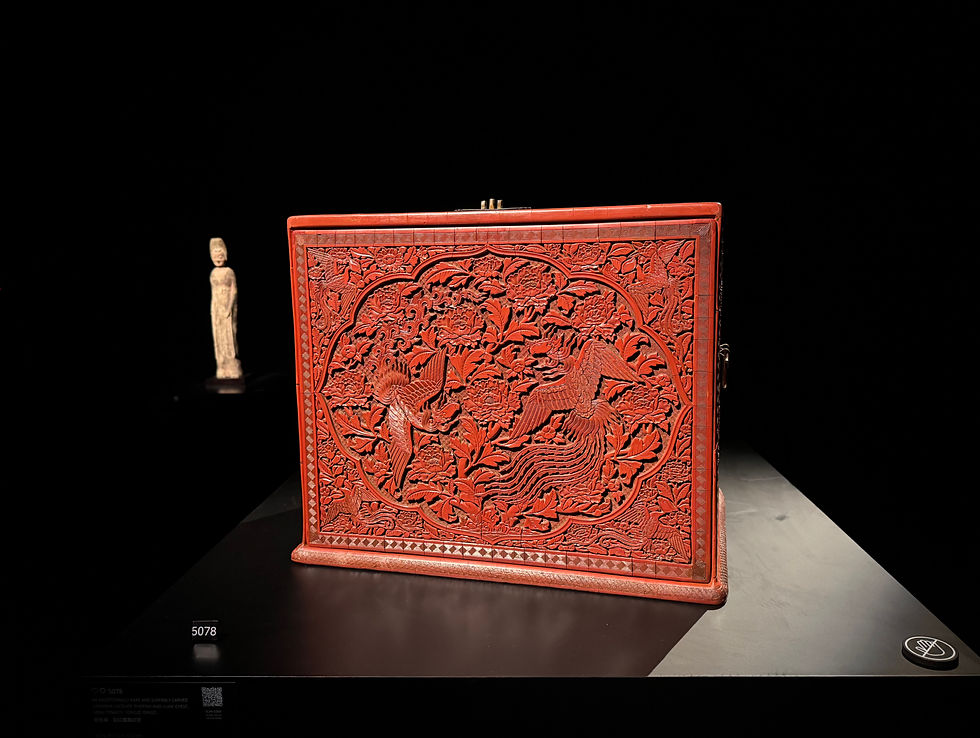
Image 8a. There were more than just ceramic and porcelain pieces at the Ise Collection. One of the most sought-after objects was this superbly carved Imperial red lacquer 'phoenix and luan' chest from the Yongle Period (1406-1425). This chest was carved on all sides with densely packed floral and fauna, and the details of the two birds, the mythical phoenix (feng) 鳳 and luan 鸞 were breathtaking. This chest sold for HKD 17.455 million (approximately CAD 3.07 million) against an estimate of HKD 20/40 million.

Image 8b. Another of my favorite pieces in this sale was an elegant and tall pottery figure of a female attendant, produced during the Northern Wei dynasty (386–535 AD). The figure stands an impressive 60.7 cm high.
Figures of this scale from the Northern Wei period are exceedingly rare. This example is further distinguished by its expressive facial features and the surviving traces of polychrome decoration across the surface.
The figure sold for many times its pre-sale estimate, achieving HKD 3.429 million (approximately CAD 603,000) against an estimate of HKD 400/800,000. This result represents one of the highest prices achieved for a Northern Wei pottery figure in many years.

Image 9. Over in the Qing Dynasty (1644-1911) part of the Ise Collection at Sotheby's was this much talked-about famille rose 'peach tree' bottle vase with Yongzheng mark and period (1723-1735). Not only was this vase of a large size at 44.6 cm, but it also had a one-of-a-kind pattern of two peach trees of contrasting pink and white floral blooms intertwined together. Unfortunately though, this vase failed to sell with its estimate of HKD 25/50 million (approximately CAD 4.4/8.8 million).

Image 10a. One Qing Dynasty porcelain piece that did sell however was the rare teadust glazed handled vase with Qianlong mark and period (1736-1795). Teadust vases do appear in the international auction market, but this particular example was exceptionally fine with its elegant shape, refinded handles, and lighter teadust glaze (typically they are a deeper green). This piece sold for HKD 5.08 million (approximately CAD 890,000 ) against an estimate of HKD 1.5/3 million.

Image 10b. The teadust vase's six-character reign mark 大清乾隆年製 daqing Qianlong nianzhi which translates to 'made during the Qianlong reign of the Qing Dynasty'. The preview room in the basement was quite dark which is why this photo turned out a bit blurry.

Image 11. While visiting the Sotheby's preview of Masterpieces of Chinese Ceramics from the Ise Collection, I was also given a rare copy of the exhibition catalogue. It is a massive cloth-bound tome with large images and essays of the items in the sale! It was a great addition to my always-expanding library.

Image 12a. My trip to Hong Kong also coincided with the opening of the Min Chiu Society’s 65th Anniversary Exhibition, Engaging Past Wisdom: Min Chiu Society at Sixty-Five, held at the Hong Kong Museum of Art.
The Min Chiu Society was founded in 1966 by a group of Hong Kong collectors dedicated to promoting the appreciation and connoisseurship of Chinese art among the general public. The Society has traditionally organized group exhibitions - typically every five years - featuring works spanning a wide range of categories, including ceramics and porcelain, jade carvings, furniture, bronzes, classical and modern scroll paintings, and religious art.
This exhibition comprises 408 objects and runs from August 8, 2025, to January 14, 2026. At the time of writing, the exhibition catalogue has not yet been published, though it is expected to be released in December.
As with the Sotheby’s exhibition, there were far too many highlights to cover in full. Instead, I have selected a few notable works from the Min Chiu Society exhibition to share here.

Image 12b. Here are the two pieces that greet visitors when entering the exhibition. The piece on left is the 'Zhou Zha Hu' 周㗬壺 an archaic bronze ritual wine vessel and cover from the middle of the Western Zhou Dynasty (10th-9th Century BC) that was once part of Emperor Qianlong's private collection. This bronze vessel was sold at Sotheby's New York in March 2024 for USD 5.4 million (you can read about it in a previous blog I put together).
The object on the right is a Ru-type porcelain vase with animal handles, with Yongzheng mark and period (1723-1735).

Image 12c. This long case displayes a selection of Peking Glass wares from the 18th Century, mostly from the Qianlong reign (1836-1795). They all showcasing different varieties of shapes, colours and levels of transparency. These vessels were the pinnacle of Chinese glass techinocoly during that period.

Image 12d. An outstanding Imperial 'dragon' robe in a gold and silk blue ground from the Qianlong Period (1736-1796) commanding its own display case.

Image 12e. There weren't that many religious sculptures showcased at this current Min Chiu exhibition, but on display were three gilt bronze Buddhist figures. From left to right they are a Tang Dynasy (618-907) seated figure of Buddha Shakyamuni, a Liao Dynasty 916-1125) standing figure of Avalokiteshvara, and a Ming Dynasty (1368-1644) seated figure of Maitreya with Yongle mark and period (1406-1425).

Image 13f. Here we have a display of 17th and 18th Century zitan 紫檀 and huanghuali 黃花梨 furniture including a four-post bed, a day-bed and a lounge chair.

Image 12g. And finally there is the very well-published Imperial iron red and famille rose 'dragon' lantern vase with Qianlong mark and period (1736-1795). This piece was juxtaposed with a cloisonné enamel vase with a similar design.
Thank you so much for reading this summer post! This will actually be a two-part post since I went to Tokyo right after visiting Hong Kong. In the next chapter I will mostly focus on my trip to the Matsuoka Museum of Art to view their famous Tang Dynasty pottery horses.
In the meantime, September will be a very busy month for me with a mid-month trip to Asia Week New York, which will then be followed by a quick trip to Vancouver for an Asian art appraisal project and to finish up cataloguing my Asian art online sale with Heffel. Please visit my site for future updates and you can always follow my Asian art adventure through my Instagram page @anthonywuart.

Comments