
Over USD 50 Million in Asian Art Sold at September Asia Week New York 2025

Updated: Mar 29
The Fall 2025 edition of Asia Week New York already feels like a distant memory. Following a long late-summer journey that took me to San Francisco, Hong Kong, and Tokyo, I spent a few days in mid-September in New York attending the Asian art previews.
New Asian art exhibitions were presented by major international auction houses such as Bonhams, Christie's, and Sotheby's, as well as regional firms including Hindman-Freeman's, Heritage Auctions, and Doyle.
The market for Asian art, particularly high-end Chinese works of art, remains robust, with strong interest from collectors worldwide. Collectors from China, Hong Kong, Taiwan, the United States, and Europe continue to play a significant role in driving demand.
As usual, the strongest-performing Asian artworks are exceptionally rare, fresh to the market, backed by outstanding provenance, and offered with conservative estimates. In total, more than USD 50 million worth of Asian art was sold during Asia Week New York.
In this blog, the focus will be on the Chinese art highlights I saw this round in New York Asia Week. (I promise to talk more about other Asian art work in future blogs!)
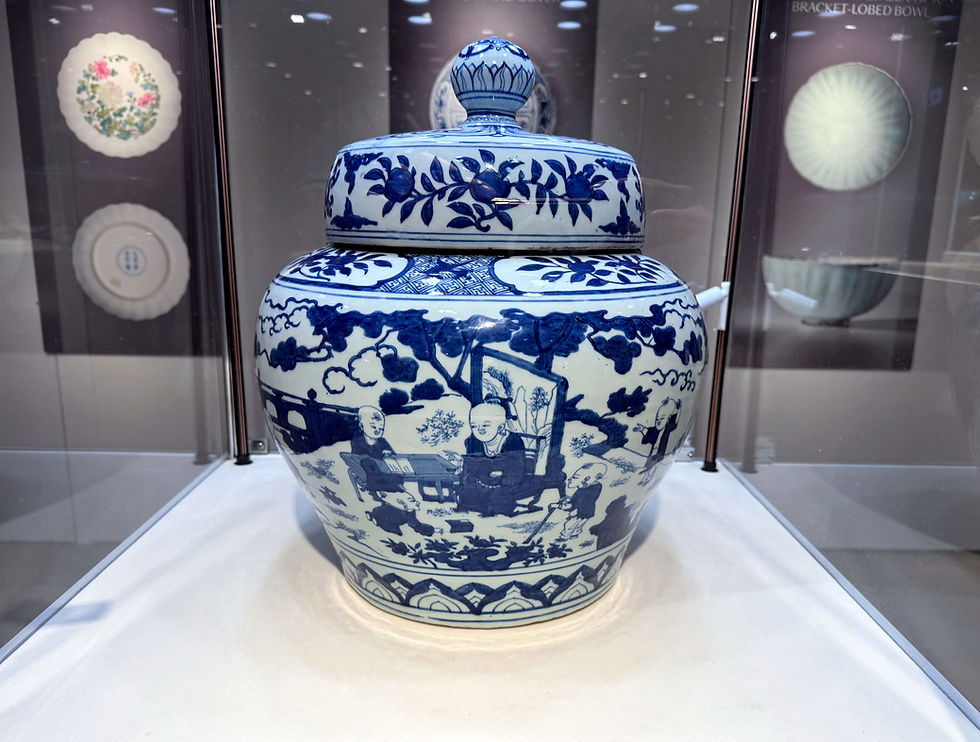
Image 1a. The two major Chinese highlights at Bonhams New York were also sent on international tour to Hong Kong in late August. This meant I was able to view them there in person rather than having to see them later in the Bonhams New York galleries. Seeing them in Hong Kong during the preview tour was a wonderful opportunity, and it spared me the need to ask the art handlers in New York to remove the works from their display cases for closer inspection.
The first of these highlights is a magnificent and large blue and white 'boys' jar and cover with Jiajing mark and period (1522–1566). The jar is particularly well-painted, displaying deep cobalt blues (some with a slight purplish tint!) and a lively design of young boys.
Each of the boys is engaged in different activities: some are reading books, one appears dressed as a monk, while another rides a hobby horse. The theme of boys in Chinese art traditionally symbolizes the wish for many sons. Their various activities also carry layered meanings, suggesting hopes that some may grow up to become scholars, monks, or even military figures.
The provenance of this jar is equally impressive, having passed through several distinguished collections:
J. M. Hu (1911–1995) Collection
The J. M. Hu Family Collection, Sotheby's New York, 29–30 November 1993, lot 238
T. T. Tsui (1941–2010) Collection
The Jingguantang Collection, Christie's Hong Kong, 5 November 1997, lot 888
Christie's Hong Kong, 27 November 2007, lot 1738
This was an exceptionally rare piece and ultimately sold for USD 1.754 million (approximately CAD 2.38 million) including buyer's premium, within its estimate of USD 1.2/1.8 million (approximately CAD 1.63/2.44 million).

Image 1b. The Jiajing blue and white 'boys' jar on the examination table.

Image 1c. I was also able to examine the cover of this this jar which was very exciting since most examples are lost. The cover has bands of peaches along the sides, and lotus lappets and flames on the surface and finial.

Image 1d. And here is an image of the base of the blue and white jar with a six-character reign mark 大明嘉靖年製 daming Jiajing nianzhi, which translates to 'made during the Jiajing reign of the Ming Dynasty'.

Image 2a. The other spectacular lot at Bonhams New York (that I viewed in Hong Kong) was this pair of famille rose 'chrysanthemum' dishes with Yongzheng mark and period (1723-1735).
The pair of dishes at Bonhams were described as being unique and possibly one-of-a-kind since there are no comparable examples recorded. Both of the dishes are enamelled in various famille rose tones, a scene of delicate multi-coloured chrysanthemums and green leafy stems. The dishes have fluted edges that also resemble chrysanthemums.
Like the 'boys' jar above, these dishes also had a strong provenance:
Collection of T. Y. Chao (1912-1999), Hong Kong
Sotheby's Hong Kong, 19 May 1987, lot 313
Shimentang Collection
Eskenazi Ltd., London, 2012
The pair of 'chrysanthemum' dishes was estimated very conservatively at USD 800,000/1,200,000 (approximately CAD1.9/1.6 million) and ended up selling for USD 1,512,500 (approximately CAD 2.06 million) including buyer's premium.

Image 2b. A close-up of one of the Yongzheng famille rose 'chrysanthemum' dishes at Bonhams.

Image 2c. The reverse of that same dish with the six-character reign mark 大清雍正年製 daqing Yongzheng nianzhi, which translates to 'made during the Yongzheng reign of the Qing Dynasty'.

Image 3a. When I visited the actual Bonhams New York sale room, I was struck by the number of interesting works that were fresh to the market. In particular, I was drawn to a group of Chinese works on paper by Chiang Yee (Jiang Yi) 蒋彝 (1903–1977), best known as 'The Silent Traveller'.
Originally from Jiangxi Province, Chiang Yee studied at Nanjing University before moving to London. There, he taught at SOAS at the University of London from 1935 to 1938. It was during this period that he began writing his celebrated Silent Traveller books, which chronicled his journeys to cities such as Oxford, Edinburgh, New York, Dublin, Tokyo and San Francisco.
Chiang Yee later relocated to the United States, where he held teaching positions at Columbia University and Harvard University.
The photo above shows several works he created himself for the 'Silent Traveller' books (on the right), alongside calligraphy and correspondence he collected from renowned Chinese literati and artist friends, including Zhang Daqian 張大千 (1899-1983), Xu Beihong 徐悲鴻 (1895-1953), Pu Ru溥儒 (1896-1963), and Liu Haisu 劉海粟 (1896-1994).

Image 3b. The auction of Chiang Yee’s collection at Bonhams included this striking self-portrait by Xu Beihong. Executed in charcoal and white chalk on brown paper, the drawing presents Chiang Yee as a dignified and composed gentleman. It also highlights Xu Beihong’s exceptional Western-style draftsmanship, a quality less often emphasized given that he is more widely known for his dynamic depictions of horses, lions, and eagles rooted in the Chinese painting tradition.
The portrait was created in 1933, during Xu Beihong’s visit to London. It has been published on numerous occasions, including Chiang Yee’s The Silent Traveller of London (1939). It was later exhibited in The Silent Traveller: Chiang Yee in Britain 1933–1955 at the Victoria and Albert Museum (2012).
The work carried a pre-sale estimate of USD 60,000/80,000 (approximately CAD 81,000–108,000), but unfortunately did not find a buyer during the auction.

Image 4. Christie’s at Rockefeller Plaza also presented a strong selection of Chinese art, with particular emphasis on Chinese classical furniture. Among the highlights was a monumental huanghuali trestle-leg table from the 17th century of the Ming Dynasty (1368-1644), which carried a pre-sale estimate of USD 800,000/1,200,000 (approximately CAD 1.1/1.66 million).
The table came from an important American collection and was originally acquired from the Eastern Pacific Company (Hei Hong Lu) in Hong Kong in 1991. It was later featured in the seminal 1996 publication Beyond the Screen: Chinese Furniture of the 16th and 17th Centuries and was exhibited as part of a long-term loan to the Museum of Fine Arts, Boston, from May 1996 to November 2017. (Note: this book has been one of the most useful Chinese furniture resources for me.)
What makes this table especially rare and desirable is the single massive plank of now-extinct huanghuali 黃花梨 wood forming its surface. Huanghuali originally came from the tropical island of Hainan but was largely exhausted by the late Qing Dynasty (1644–1911), making surviving examples extraordinarily scarce today. It is an extremely slow-growing tropical wood that is known for its lush honey-golden graining.
As huanghuali belongs to the rosewood family, it is now subject to strict international export and import regulations. Nevertheless, when a truly exceptional example appears, international collectors are often willing to take the risk and pursue acquisition through auction. After intense competitive bidding, this remarkable table ultimately sold for USD 2.271 million (approximately CAD 3.14 million) including buyer's comission.
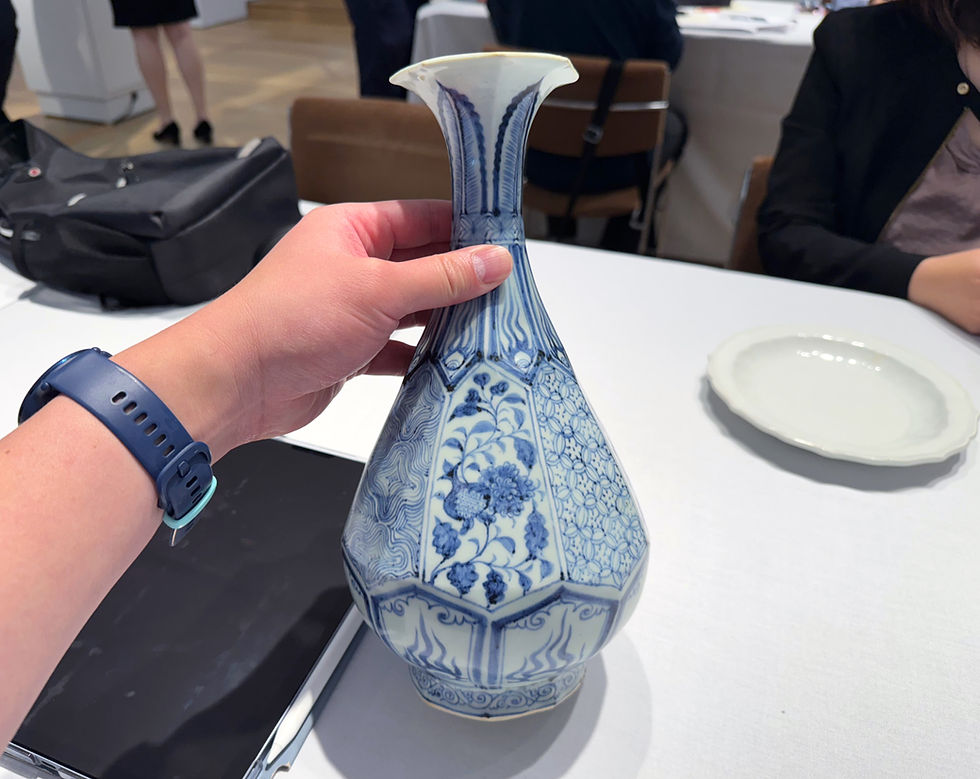
Image 5a. Also at Christie's was a wonderful selection of Chinese porcelain wares from the Yuan to the Qing Dynasty. Of the Yuan Dynasty (1279-1368) pieces, I particularly liked this blue and white faceted pear-shaped vase.
In addition to the beautiful patterns on the body, which includes pomegranates, coins, and wood graining, the rarity of this piece is the neck and rim are intact. The majority of these Yuan Dynasty bottle vases would have had losses or restorations to the neck area.
Against an estimate of USD 80,000/120,000 (approximately CAD 110,000/165,000), this bottle vase realized USD 596,900 (approximately CAD 824,000).

Image 5b. Examining the base of this Yuan Dynasty blue and white pear-shaped vase.

Image 6a. With respect to Ming Dynasty porcelain at Christie's, the favourite was this rare and small blue and white jar with Xuande mark and period (1426-1435). It has numerous levels of provenance and can be traced back to over 50 years including:
Mrs. B. Macpherson Collection
The Property of Mrs. B. Macpherson; Sotheby's London, 27 November 1973, lot 217
Eskenazi Ltd., London
Sotheby's Hong Kong, 28 November 1978, lot 61
Sotheby's Hong Kong, 30 April 1991, lot 15
This jar is exquisite with its fine design of loquats and peaches and was described in the catalogue as not having any comparables. This piece was extremely popular during the auction previews since it is very rare for Xuande mark and period porcelain to be showcased in New York, as opposed to the larger Hong Kong market.
In consequence, many of the top international collectors were after this little jar, which achieved a very strong price of USD 1.542 million (approximately CAD 2.13 million) against an estimate of USD 350,000/450,000 (approximately 483,000/621,000).

Image 6b. The base of the small blue and white jar and the reign mark 大明宣德年製 daming Xuande nianzhi, which translates to 'made during the Xuande reign of the Ming Dynasty'.

Image 7a. In the Qing Dynasty porcelain category at Christie’s, some of the most exciting works on view during September Asia Week were two Imperial falangcai cups, each bearing Yongzheng yuzhi marks and of the period (1723–1735).
Falangcai 琺琅彩, which literally translates as ‘foreign colours,’ refers to a rare enamelling technique introduced to China in the early 18th century by Jesuit Priests. Drawing on European materials and technology, these enamels introduced new colours and decorative approaches that differed markedly from traditional Chinese aesthetics, often appearing distinctly European in character. The yuzhi 御製 mark, meaning 'made by imperial command,' indicates that these pieces were produced directly for the emperor.
I was fortunate to examine both of these cups side by side. Lot 1050 (right) was a ruby-red ground cup decorated with orange floral motifs, while lot 1041 (left) featured a coral ground with floral medallions. Both cups carried auction estimates of USD 300,000/500,000 (approximately CAD 414,000/690,000) and came from the descendants of Thomas R. Vaughn (1908–1979), a lawyer with Freeport Minerals Company. Vaughn was a well-known collector of Qing porcelain and acquired many of his pieces from the renowned New York dealer Frank Caro (1904–1980).

Image 7b. Close up of lot 1050, the Imperial ruby-ground falangcai cup. This piece realized USD 1,587,500 (approximately CAD 2.19 million).

Image 7c. Close up of lot 1051, the Imperial coral-ground falangcai cup. This piece realized USD 863,600 (approximately CAD 1.192 million).

Image 7d. The two falangcai cups on the examination table displaying their four-character reign marks 雍正御製 Yongzheng yuzhi (made by Imperial command for the Yongzheng Emperor).

Image 8a. Next up was the Chinese Art sale at Sotheby's on New York’s Upper East Side. This was a bittersweet moment for me, as I have been attending their previews and auctions at the York Avenue location since 2008. Later this fall, Sotheby’s will be moving to a new gallery space. In November, they will occupy the legendary Breuer Building at 945 Madison Avenue, formerly home to the Whitney Museum of American Art.
There will still be numerous highlights at Sotheby’s before the move, and one of these was a rare gilt-lacquered bronze figure of Acuoye Guanyin. The sculpture depicts the Buddhist bodhisattva of compassion in the 'All-Victorious' iconography and was produced in the mysterious Dali Kingdom, present-day Yunnan Province, during the 11th to 12th Century.
The figure is characterized by its very tall and slender proportions and features hand gestures in a rare preaching pose. It can be confidently identified as Guanyin due to the miniature figure of Amida Buddha incorporated into the crown. The sculpture carried a pre-sale estimate of USD 400,000/800,000 (approximately CAD 552,000/1.1 million) and ultimately sold for USD 889,000 (approximately CAD 1.23 million).

Image 8b. A photo of me holding this rare bronze figure of Guanyin at Sotheby's. The sculpture was actually quite heavy!

Image 8c. The reverse of the Guanyin figure.

Image 9. In the Chinese jade category at Sotheby's New York, one of the pieces I really liked was this white jade 'phoenix' censer and cover from the Qianlong Period (1736-1795). It was extremely attractive with the archaistic patterns on the body and cover, and the well-carved stylized phoenix handles. This piece originally came from Nagatani, a famous Chicago dealer, during the 1970's. The censer and cover was estimated at USD 30,000/50,000 (approximately CAD 41,000/69,000) and had a final sale price of USD 165,100 (approximately CAD 228,000).

Image 10a. Also at Sotheby's was one of the most anticipated items in this edition of New York Asia Week. Here they featured an extremely rare famille rose 'peony, magnolia and peach blossom' vase with Yongzheng mark and period (1723-1735)
This form of vase with a globular body and thick neck is called a tianqiuping 天球瓶, which literally translates to a 'heavenly sphere vase'. The majority of these types of vases were made for the Imperial court and sometimes dedicated directly to the emperor. For this present example, the quality of the painting and enamels is simply breathtaking. The florals, leaves and stems are especially vibrant and lifelike, making it almost seem like a Chinese court painting imposed on a three-dimensional vase.
The provenance of this piece was also quite illustrious since it came through numerous Sotheby's auctions including:
Sotheby's Hong Kong, 9th November 1982, lot 313
Sotheby's Hong Kong, 29th October 1991, lot 252
The vase was also displayed at the National Museum of History in Taipei as part of a 1995 Ching Wan Society exhibition. The Ching Wan Society is a renowned group of Chinese art collectors from Taiwan.
Remarkably, this vase had an extremely low auction estimate of USD 400,000/600,000 (approximately CAD 552,000/828,000). This was most likely a strategy by the Sotheby's specialists and the consignor to attract as much interest as possible. And the plan worked! This stunning vase sold for six times more than its estimate, realizing USD 2.612 million (approximately CAD 3.61 million).

Image 10b. A magnificent view of the magnificent famille rose tianqiuping vase on the examination table at Sotheby's New York.

Image 10c. The six-character reign mark of the vase reads 大清雍正年製 daqing Yongzheng nianzhi, which translates to 'made during the Yongzheng reign of the Qing Dynasty'.

Image 11. And one final 'cute' highlight at Sotheby's was this extremely endearing gold and silver inlaid mythical beast from the Han Dynasty (206 BC - 220 AD). This creature is probably a bixie 辟邪, a single-horned lion-like animal that is a protector and provider of good fortune. Its body is extremely dynamic and you can see the fine details in its paws, wings, and gaping jaw. The quality of the gold and silver inlays are really something to behold! This mythical beast sold for USD 393,700 (approximately CAD 544,000) against an estimate of USD 80,000/120,000 (approximately CAD 110,000/165,000.

Image 12a. And finally at the regional auction house Hindman-Freeman's were a selection of lovely Chinese blue and white porcelain pieces that I had the pleasure of examining. They might not be as high profile as many of the Chinese artworks from the larger auction houses featured in this blog, but these items were still very enjoyable to look at and felt relatively 'attainable'.
One piece I particular piece I liked was this blue and white 'dragon' bowl with Kangxi mark and period (1662-1722). It has a very classic-looking Kangxi dragon soaring over a heavenly sky. This attractive bowl sold for USD 35,200 (approximately CAD 48,600) against a conservative estimate of USD 5,000/7,000 (approximately CAD 6,900/9,600).

Image 12b. The six-character reign mark of this bowl reads 大清康熙年製 daqing Kangxi nianzhi, which translates to 'made during the Kangxi reign of the Qing Dynasty'.

Image 13. And finally, I really had the pleasure of viewing this wonderfully-painted and large blue and white 'figural' brushpot from the Chongzhen Period (1628-1644) at Hindman-Freeman's. Chongzhen marks the last period of the Ming Dynasty, and their porcelain pieces, like this exmaple, often have some of the best painted narrative stories in Chinese art. This particular brushpot did have some minor restorations to the base, but still sold for USD 44,800 (approximately CAD 62,000) against an estimate of USD 20,000/30,000 (approximately CAD 27,000/41,000).
Thank you for reading this blog and please follow me on my Instagram account @anthonywuart for updates on my international Asian art adventures! Currently I am in Toronto for the month of October overseeing my Asian art preview and online auction in collaboration with Heffel. If you are in the area, please stop by at the gallery at 13 Hazelton Avenue to say hi! In my next blog I will go through the results of this very exciting sale.


Comments